


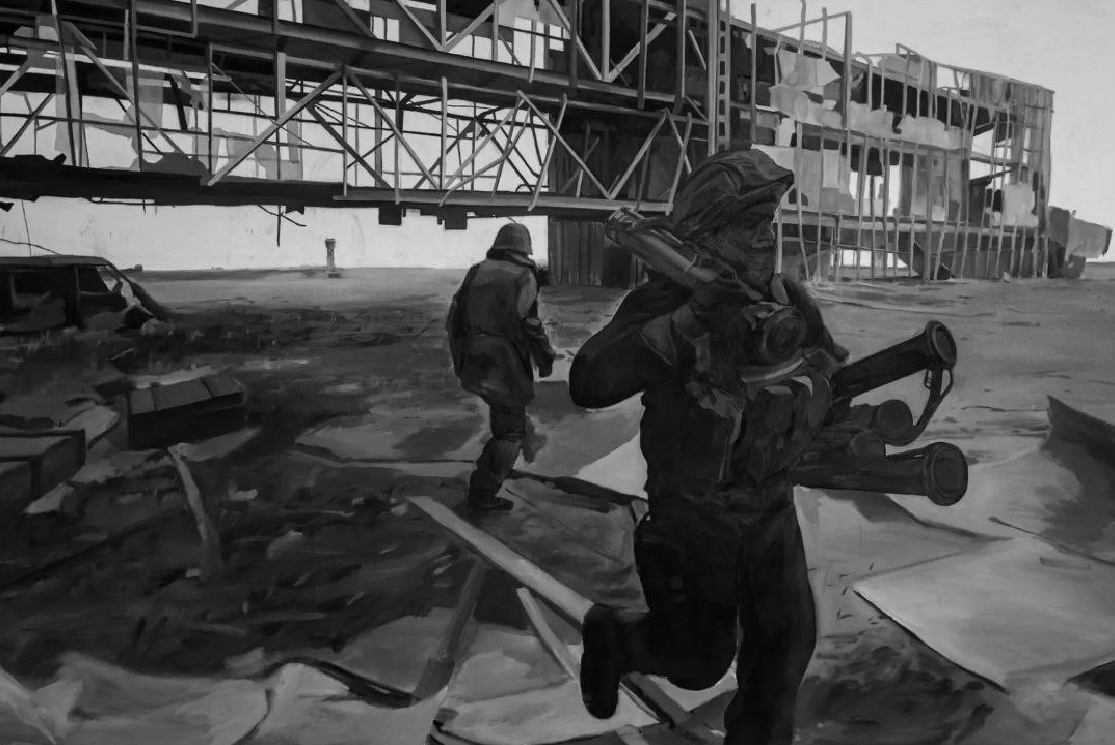
On January 20, we honor the memory and heroism of the indomitable warriors—the defenders of Donetsk Airport. They became known as the “Cyborgs”—warriors who stayed true to Ukraine, fought for every meter of its land, and held back the enemy’s advance.
The battle for Donetsk Airport began in the first days following the occupation of Donetsk in late May 2014. Day after day, under constant enemy attacks, in terminals and other airport buildings riddled with shelling, the defenders proved to the entire world that Ukraine would not surrender and would continue to resist. The “Cyborgs” did not give up—but the buildings’ structures could not withstand the destruction. On January 13, 2015, the control tower collapsed. On January 19, militants blew up the concrete floors of the new terminal for the first time; on January 20, they did so again. On January 21, the final fighting for the airport came to an end. On January 23, a group of snipers withdrew from their position in the fire station.
During the fierce fighting, more than 200 servicemen were killed and over 500 were wounded. Many of the defenders were awarded state honors. Ihor Branovytskyi, Ihor Zinich, Ivan Zubkov, Serhii Tabala, Serhii Kolodii, Maksym Rydzanych, and Petro Polytsiakh were posthumously awarded the title Hero of Ukraine.
The defense of the Donetsk Airport is a story of thousands of acts of courage and heroism. In honor of the “cyborgs,” documentary films and books have been created, and the defenders have become the subjects of television and radio programs. Their feat has been commemorated with a memorial coin issued by the National Bank of Ukraine and a special postage stamp released by Ukrposhta.
At the War Museum, the heroic defense of the airport has been the subject of numerous exhibitions, as well as many commemorative and educational events. As early as 2015, the Museum presented the exhibition “Donetsk Airport Through the Lens of Serhii Loiko.” It was based on photographs by the renowned correspondent of the Los Angeles Times — the only representative of foreign media who was present at the airport during the siege. It was he who donated these unique images to our institution. The photographs displayed in the exhibition, like his other works, later traveled across Ukraine, revealing to visitors the atmosphere of the struggle for the Ukrainian airfield. During one of the exhibitions, the author himself admitted: “In a sense, I was lucky to have been able to photograph a small part of the chronicle of this war. And these heroes, whose photos hang on these walls, who are present here in this hall, and who are still in the trenches today — they are real personalities, real heroes, who are accomplishing a feat…”
A special project prepared by the Museum for the first anniversary of the events was the exhibition “Airport… Hellish Runway,” which was on display from January 20 to August 25, 2016. Materials for the exhibition were collected from all across Ukraine. The most precious items preserving the memory of the fallen defenders of the airfield were photographs, documents, and personal belongings, which were donated to the Museum by the parents, wives, and relatives of those who had been killed. From different parts of the country — where the demobilized defenders of the Donetsk stronghold were serving or living at the time — the “cyborgs” sent their military gear by post or through volunteers: equipment imbued with the smell of smoke and covered in airport dust and soot.
Among the exhibits of this exhibition were also two vehicles. An Isuzu Trooper SUV, used by reconnaissance troops of the 3rd Separate Special Forces Regiment during the defense of the Donetsk Airport, was brought to the exhibition from the Kirovohrad region. Also on display was a Niva vehicle that had belonged to the fallen “cyborg” Ivan Zubkov from the Khmelnytskyi region, the company commander of the 90th Separate Airmobile Battalion, which now bears his name.
The central focal point of the exhibition was the installation Hell’s Gate to the Sky, dedicated to the last defenders of the airport who were killed beneath the collapsed structure, when even steel and concrete could no longer withstand the trial by fire.
The exhibition project became a unique platform for meetings and discussions among visitors—scholars, museum professionals, engaged members of the public, young people, and direct participants in the events: Ukrainian soldiers and their family members. While exploring the exhibition, visitors immersed themselves in the atmosphere of the Ukrainian struggle, reflected on their own stance toward the war, felt its closeness and their bond with the defenders, and contemplated the future. In the Museum’s guestbook, among the many words of gratitude and admiration for the exhibition, one entry reads: “…Living history! You can even touch it! Such museums are necessary so that, having seen, one may understand: ‘God forbid war!’ in any of its forms. Time passes—wounds heal. Memory is eternal! Ukraine, you are strong!”
The story of the legendary defense of Donetsk Airport was further developed in the exhibition project Ukrainian East (on display from September 2019 to February 2022), which the media described as “the largest exhibition about the war in Donbas.” The project was implemented in cooperation with the Amyseum team with the support of the Ukrainian Cultural Foundation.
The exhibition featured more than 2,000 items collected over the years of the Russian-Ukrainian war, including documents, photographs, personal belongings, books, weapons, unit flags, road signs, and the vehicles of the defenders. In the “Airport” section, through installations and accompanying texts, visitors were able to explore the chronology of events that unfolded around and directly on the territory of the airfield, to “touch” the belongings of the defenders—those who fought the enemy on the runway, held the terminals (both the old and the new), the control tower, and the fire station; the stories of those who refused evacuation and stayed with the wounded, those who were taken captive, those who managed to escape from the destroyed terminal, and those who remained buried beneath its ruins and were only later identified and laid to rest.
Over the years, the indomitable “cyborgs” gathered at the War Museum to honor the memory of their fallen brothers-in-arms and to speak to young people about their feats. One of the frequent guests and speakers at these events was Ruslan Borovyk (“Baghdad”). When he set out to defend the airport, he took a camera with him. At the time, he did not yet know that his photographs would capture the final days of his fallen comrades and unique episodes of the defense of the airfield. It is symbolic that in January 2022, the Day of Remembrance of the Defenders of Donetsk Airport was held with the participation of Ruslan Borovyk. As it turned out, that meeting was the last one. With the beginning of russia’s full-scale invasion, Ruslan returned to the Defense Forces of Ukraine and was killed on April 30, 2022, in a fierce battle near the city of Izium in the Kharkiv region.
Most of the defenders of Donetsk Airport returned to the front lines in the very first days of russia’s full-scale invasion in February 2022. Many of them sacrificed their lives for Ukraine.
However, the “Cyborgs” not only inscribed an unprecedented chapter of resilience and courage into our history, but also became a model for a new generation of defenders — a seed that has grown into patriotism and love for Ukraine.
To mark the 10th anniversary of the battles for Donetsk Airport, the War Museum opened the exhibition “Airport.242” (on view from 20 January to 17 February 2025). The exhibition presented 24 artworks by artist, volunteer, and serviceman Oleh Drobotskyi (“Khudozhnyk” / “The Artist”), who was killed in action on 6 March 2023 near the village of Orikhovo-Vasylivka in the Bakhmut district. The works on display were created based on photographs by Serhii Loiko.
At the exhibition opening, the artist’s father recalled how Oleh came up with the idea of painting the “Cyborgs” and Donetsk Airport: “The battle for the airport inspired him immediately. In time, Oleh created an entire series of works that was exhibited both in Ukraine and abroad. He himself also took up arms. The ‘Cyborgs’ gave him and his comrades the motivation to defend their country. Oleh was killed… but his works continue to tell the story of our warriors.”
The story of the battle for Donetsk Airport has already entered history textbooks, and the Museum will continue to tell the story of its defenders.

Iryna Kotsabyuk
Head of the Memorialization Sector